🦥🐓🦥The Food Chain🦥🐓🦥
Welcome 👦👧boys and girls to another class. Today, we will be going on an adventure where we will be exploring the topic: The Food Chain. Read all given information, watch the video clips and do the activities below.
What is a Food Chain?
Definition:
A food chain is a diagram that shows how energy and food pass from one living
thing to another. It shows "who eats whom."
The Big Idea: A food chain shows the path of energy. It shows us "who eats whom" to survive. The arrows point in the direction the energy travels (towards the mouth of the hungry animal!).
Key Information:
- Producers:
These are living things that make their own food. Plants are the most
common producers. They use sunlight to make food (this is called
photosynthesis). They are always at the beginning of a food chain.
- Consumers:
These are living things that cannot make their own food and must eat other
living things. There are three types:
- Primary
Consumers (Herbivores): Animals that eat
only plants. (e.g., a rabbit eating grass).
- Secondary
Consumers (Carnivores or Omnivores): Animals
that eat other animals. (e.g., a snake eating a rabbit).
- Tertiary
Consumers (Top Carnivores): Animals that eat
other carnivores. They are often at the top of the food chain. (e.g., a
hawk eating a snake).
- Decomposers:
These are living things like bacteria and fungi that break down dead
plants and animals. They return nutrients to the soil, which helps plants
grow. They are the "recyclers" of the ecosystem.
- Energy
Flow: The sun is the main source of energy for almost
all food chains. Energy moves from the sun → producer → primary consumer →
secondary consumer, and so on. Only about 10% of energy is passed from one
level to the next. The rest is lost as heat.
Example of a Simple Food Chain:
Sun → Grass (Producer) → Rabbit (Primary Consumer) → Fox (Secondary Consumer) →
Decomposers (bacteria in the soil)
1.Reading and Understanding the Food Chain
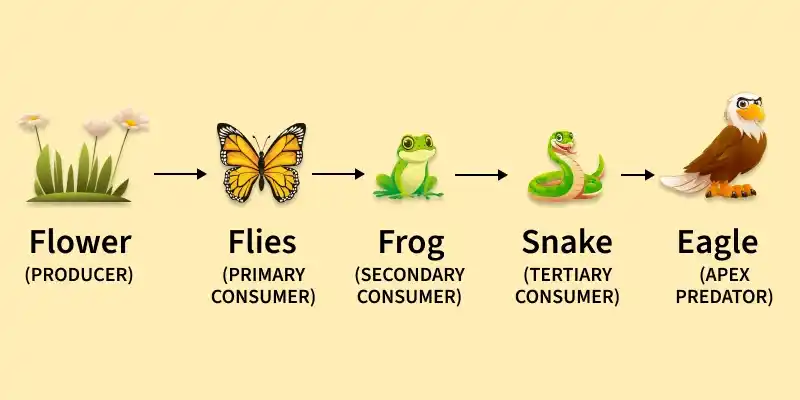
The Big Idea:
A food chain shows the path of energy. It shows us "who eats whom" to
survive. The arrows point in the direction the energy travels (towards the
mouth of the hungry animal!).
Here is the step-by-step breakdown:
1.
Flower (Producer):
The chain starts with the flower. It is a Producer because it makes its
own food using sunlight. It is the source of energy for everyone else.
2.
Butterfly (Primary Consumer): The
butterfly eats the flower (nectar). It is the first animal to get energy from
the plant, so it is the Primary Consumer. (Note: The image labels it
"Flies," meaning the butterfly flies, but it is still the first
consumer.)
3.
Frog (Secondary Consumer):
The frog eats the butterfly. It gets its energy second-hand, so it is the Secondary
Consumer.
4.
Snake (Tertiary Consumer):
The snake eats the frog. "Tertiary" means third, so it is the third
animal in the line to eat.
5. Eagle (Apex Predator): The eagle eats the snake. It is at the very top of this food chain. "Apex" means top, and "Predator" means hunter. No other animal in this picture hunts the eagle.
2.Understanding the Food Chain
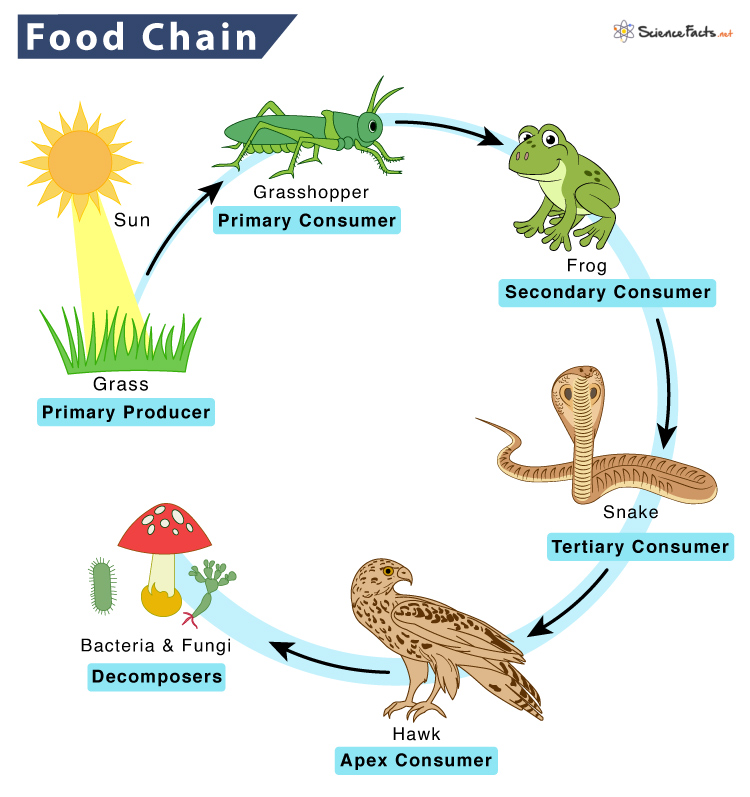
1.
The Sun:
Everything starts with the sun. It gives energy to the plants.
2.
Primary Producer (Grass):
The grass uses sunlight to make its own food. Because it makes its own food, it
is called a "Producer."
3.
Primary Consumer (Grasshopper):
The grasshopper eats the grass. Because it eats plants, it is the first animal
in the chain (Primary Consumer).
4.
Secondary Consumer (Frog):
The frog eats the grasshopper. It is a carnivore (meat-eater) and comes second
in the chain.
5.
Tertiary Consumer (Snake): The
snake eats the frog. It is the third consumer and a predator.
6.
Apex Consumer (Hawk):
The hawk eats the snake. "Apex" means top. The hawk is at the very
top of this chain and has no natural predators here.
7. Decomposers (Bacteria & Fungi): When the hawk eventually dies, or leaves waste, bacteria and fungi break down its body. They turn the dead matter back into nutrients in the soil, which helps the grass grow again. This completes the cycle.
👦👧Boys and girls let us watch the video clips on the food chain👇
Click and watch the video Click and watch the video Click and watch the video
👦👧Now that we have learnt about the uses of the environment. Boys and girls, it's activities time!!!
This section has five different sets of question do all of them.
Task 1: Read the questions before writing your answers.
1.
What is a living thing that makes its own
food called?
a) Consumer
b) Decomposer
c) Producer
d) Predator
2.
What is the main source of energy for
almost all food chains?
a) The moon
b) The sun
c) Water
d) Soil
3.
An animal that eats only plants is called
a...
a) Carnivore
b) Omnivore
c) Herbivore
d) Decomposer
4.
Which of these is a decomposer?
a) A mushroom
b) A rabbit
c) A grasshopper
d) A hawk
5.
In the food chain "Sun → Grass → Cow
→ Human," what is the cow?
a) A producer
b) A primary consumer
c) A secondary consumer
d) A decomposer
6.
What is the correct order of energy flow
in a food chain?
a) Consumer → Producer → Decomposer
b) Producer → Consumer → Decomposer
c) Decomposer → Consumer → Producer
d) Sun → Decomposer → Producer
7.
Why are producers always at the beginning
of a food chain?
a) Because they are the biggest organisms.
b) Because they are the only ones that can make their own food from sunlight.
c) Because they eat the consumers.
d) Because they are the fastest.
8.
Which of the following is a secondary
consumer?
a) A grasshopper eating grass
b) A frog eating a grasshopper
c) A plant making food
d) A worm breaking down a dead leaf
9.
What would happen to a food chain if all
the producers were removed?
a) The consumers would find other food.
b) The food chain would collapse because there would be no energy source.
c) The decomposers would become producers.
d) Nothing would happen.
10.
What is the role of a decomposer in a food
chain?
a) To eat primary consumers
b) To make food from sunlight
c) To break down dead organisms and return nutrients to the soil
d) To provide energy to the sun
11.
A food chain shows a hawk eating a snake,
which ate a mouse, which ate grass. If a disease kills all the snakes, what is
the most likely immediate effect?
a) The hawk population will increase.
b) The mouse population will decrease.
c) The mouse population will increase.
d) The grass population will decrease.
12.
In a forest, rabbits eat plants. Foxes eat
rabbits. A new predator that also eats rabbits moves into the forest. What will
happen to the fox population?
a) It will likely increase because there is more food.
b) It will likely decrease because there is more competition for food.
c) It will stay the same.
d) The foxes will start eating plants.
13.
Why is a food chain often represented as a
pyramid?
a) Because it is a simple shape.
b) Because there are fewer producers than consumers.
c) Because energy is lost at each level, so there are fewer organisms at the
top.
d) Because the sun is at the top.
14.
A farmer notices that his cornfield has
many grasshoppers. He also sees many birds eating the grasshoppers. If he
sprays a chemical that kills the grasshoppers, what might happen to the birds?
a) The birds will eat the corn.
b) The birds will have less food and their numbers may drop.
c) The birds will become decomposers.
d) The birds will help the grasshoppers grow.
15.
Which of these is the most complete food
chain?
a) Sun → Grass → Rabbit
b) Grass → Rabbit → Fox → Decomposer
c) Sun → Grass → Rabbit → Fox → Decomposer
d) Rabbit → Fox → Decomposer
16.
Imagine an ecosystem with no decomposers.
What would be the long-term effect?
a) Dead plants and animals would pile up, and nutrients would not be returned
to the soil.
b) Producers would grow faster.
c) Consumers would have more food.
d) The sun would stop shining.
17.
If a disease wiped out all the producers
in an ecosystem, which group would be affected first?
a) Decomposers
b) Primary Consumers
c) Secondary Consumers
d) Tertiary Consumers
18.
A food web is more realistic than a food
chain because...
a) It shows many different connections between organisms.
b) It only shows one path of energy.
c) It is easier to draw.
d) It only includes producers.
19.
Two food chains are:
Chain A: Grass → Deer → Wolf
Chain B: Grass → Rabbit → Fox
If a disease kills all the deer, what happens to the wolves?
a) They will start eating grass.
b) They may die out or move to find other food.
c) They will eat the rabbits.
d) They will become producers.
20.
Why is the sun considered the ultimate
source of energy?
a) Because it is the biggest object in the sky.
b) Because it provides light and heat for producers to make food.
c) Because it eats the producers.
d) Because it is a consumer.
Task 2: answer all questions
in this section.
1.A scientist is studying a pond. The food chain is: Algae (Producer) →
Mosquito Larvae (Primary Consumer) → Small Fish (Secondary Consumer) → Frogs
(Tertiary Consumer). One year, the scientist notices that the frog population
has dropped dramatically.
Question 1: Using your
knowledge of food chains, explain what might have happened to the small fish
and mosquito larvae populations. Why? (4 marks)
2.A gardener has a vegetable garden with lettuce and carrots. She notices that
aphids (tiny insects) are eating her lettuce. Ladybugs, which eat aphids, are
also in the garden. One day, a new type of bird moves into the garden and
starts eating the ladybugs.
Question 2:
Predict what will happen to the aphid population and the lettuce plants.
Explain your reasoning. (4 marks)
3.In a forest, a large tree falls over and dies. Over
the next few months, the fallen tree is covered in fungi and bacteria. It
slowly breaks down and becomes part of the soil.
Question 3:
Explain why the fungi and bacteria are important for the other plants and
animals in the forest. What would happen if they were not there? (4 marks)
Task 3: Answer all given
questions.
1.
In your own words, explain the difference
between a producer and a consumer.
2.
Draw a simple food chain with at least
three organisms. Label the producer and the consumers.
3.
Why do you think there are fewer top
predators (like lions or hawks) than primary consumers (like rabbits or
insects) in an ecosystem?
4.
What is a decomposer? Give two examples
and explain what they do.
5.
Imagine you are a producer (a plant).
Write a short paragraph describing your role in the food chain.
6.
Explain how the sun's energy gets into
your body when you eat a hamburger.
7.
What might happen to an ecosystem if a new
animal that has no natural predators is introduced?
8.
Why are food webs considered more
realistic than a simple food chain?
Task 4: Write true or false
beside each statement.
1.
A food chain always starts with the sun.
2.
A consumer is a living thing that makes
its own food.
3.
A herbivore is a type of consumer.
4.
Decomposers break down dead plants and
animals.
5.
Energy is lost as heat at every step of a
food chain.
6.
A snake that eats a mouse is a primary
consumer.
7.
Plants are producers.
8.
In a food chain, the arrow points from the
eater to the eaten.
9.
Fungi are decomposers.
10.
A food chain and a food web are the same
thing.
Task 5: Use the words from
the word bank to complete each item below.
Word Bank:
Energy, Decomposers, Sun, Producer, Consumer, Herbivore, Carnivore, Food Web
1.
A ____________ is a living thing that
makes its own food.
2.
The main source of ____________ for a food
chain comes from the ____________.
3.
An animal that eats only other animals is
called a ____________.
4.
____________ are organisms that break down
dead material and return nutrients to the soil.
5.
A ____________ is a living thing that must
eat other living things to survive.
6.
An animal that eats only plants is called
a ____________.
7.
A ____________ shows many interconnected
food chains in an ecosystem.
8.
The arrow in a food chain shows the
direction that ____________ flows.
Liveworksheet Activities


Comments
Post a Comment